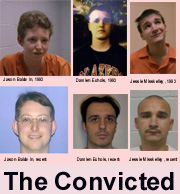
Physical evidence available for DNA analysis
We each have a unique sequence of DNA. By the nature of its uniqueness, DNA can be used to identify the source of biological evidence specimens including hair, blood, semen and saliva.
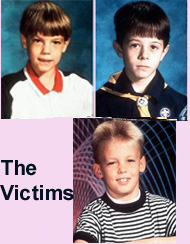
During the course of the investigation blood and/or hair samples were provided by 47 individuals and the three victims. Some of these, such as Amanda Hobbs, the 4 year old sister of Stevie Branch, were solely to ensure that the sample was not transferred during innocent contact. Others were taken because the subject was considered a suspect. The lists below were compiled from the evidence list and the reports from Genetic Designs. Other specimens taken from these individuals are mentioned separately in parentheses, other spellings of the names are listed in brackets.
Those with rape kits taken. (Blood, head and pubic hairs, and saliva)
- Robert Burch
- Richard Cummings, Jr.
- Richard DeAngelo
- Tim Dodson
- Damien Echols
- Daniel Lefler [Kefler]
- Traci Laxton
- Thomas Poletta
- Steven Skaggs
- William Welch
Those with blood, head and pubic hairs taken.
- Anthony Barnes
- John Mark Byers (also knife)
- Charles Craig
- Joe W. Gooch
- Michael Headlee (also knife)
- Thomas Holland (also urine and swabs)
- LG Hollingsworth
- Michael Leiter
- David Looney
- Buddy Lucas
- James K. Martin
- Steve Menard (also urine and fingernail clippings)
- Roy Todd Moore
- Christopher Morgan (also urine and swabs)
- Charles P. Morton
- Lance Renshaw
Those with blood and hair taken.
- Jason Baldwin
- Melissa Byers
- Ryan Clark
- Jessie Misskelley
- The victims.
Those with head and/or pubic hair taken.
- King David Beasley
- Kenneth Cagle (pubic hairs only)
- Gary Ray Chadwick
- Lynn Lucas
- Jerry Nearns
- Bryn Ridge (head hair only)
- Bruce Strickland
- John Witner [Winters]
- David Shane Wren
Other family members of the victims with head hair samples taken.
- Sherri Branch
- Steve Branch
- Amanda Hobbs
- Terry W. Hobbs
- Pamela Hobbs
- Dawn Moore
- Diana Moore
- Ricky L. Murray
Although all of these subjects had samples taken into evidence, the only ones who had DNA analyses were the victims, the three arrested, the Byers household (Melissa and John Mark Byers and Ryan Clark - after a knife was presented to the police with blood on it), Richard Cummings and Steve Menard. These were analyzed using a method called HLA DQalpha, a process described further below.
Along with samples from individuals, the state also tested several pieces of evidence for DNA. Some of these tested negative.
Q6.(2S) Cutting from blue jeans: questioned stain. (No result)
Q10.(1S) Cutting from blue jeans: questioned stain. (No result)
Q37. Possible tissue recovered from knife. (DNA not found)
Q4. Possible tissue recovered from ligature from Christopher Byers. (DNA not found)
Q39. Possible tissue recovered from ligature from Michael Moore. (DNA not found)
Q52. Blood stain on shirt from Steve Menard. (matched his HLA DQalpha type)
Q85. Blood stain on shirt from Jessie Misskelley (matched his HLA DQalpha type and the type from Michael Moore.)
"Hair specimen 1/18/94" Matched HLA DQalpha type of John Mark Byers and Christopher Byers.
Blood on Kershaw knife. Matched HLA DQalpha type of John Mark Byers and Christopher Byers.
Blood on pendant. Matched HLA DQalpha type of Jason Baldwin and Steve Branch.
In addition, there were hairs gathered at the crime scene which were not tested by DNA analysis. These along with the samples requested for testing by the appeals lawyer will be discussed in forthcoming pages. In theory, all of the gathered biological evidence can be compared to samples provided by suspects to try to identify the killers.
DNA Fingerprinting
DNA defines who we are: our sizes, our shapes, our faces, our health. DNA is inside most cells in our bodies. The nuclear DNA from one cell has all of the information to create an exact physical duplicate of who we are, a device used in science fiction depictions of cloning. DNA from a biological sample can be matched to its source.
Basic definitions.
Genes. This word can have several meanings. The common colloquial one is "inherited traits." It can also mean a piece of DNA that codes for these traits.
DNA. The chemical that codes for the physical characteristics of all organisms, including humans. It is shaped like a spiral staircase. It is often compared to a blueprint. Perhaps a better analogy is a book, with letters making words and words making sentences, all combining to describe how to make the human. The book is long - in humans it is approximately 3 billion "letters." The abbreviation DNA stands for deoxyribonucleic acid, a chemical that is a long chain of "nucleotides" also called "bases" or "base pairs." From the above analogy, each "letter" is a single nucleotide. The term DNA usually refers to the genetic material in the cell nucleus, although other DNA can be analyzed, including DNA in the mitochondria.
Chromosomes. Paired strands of DNA. Humans have 23 pairs of chromosomes. A child receives half of his chromosomes from his father and half from his mother. This combination of chromosomes is unique for each individual with the exception of identical twins. A single chromosome is also called an allele.
Cells. The unit of structure that makes up our tissues. The most relevant cells in forensic work are from blood, semen, saliva, hair and skin because these can commonly be left at a crime scene. It is also possible that the perpetrator can pick up blood, hair or other matter from the victim.
Cell nucleus. The control center of the cell, where the nuclear DNA is kept.
Mitochondria. Small bodies inside a cell that divide on their own and have their own genes, mtDNA. mtDNA can be found in cells without a nucleus, such as those that make up the shafts of hairs. This form of DNA is directly inherited from one's mother.
History of DNA fingerprinting and RFLP
Because DNA has all of the information to define who we are, our DNA can be used as a unique means of identifying us. The first method that used DNA as a means of fingerprinting was presented in 1985 in the journal Nature. This method, dominant for the next ten years, was called restriction fragment length polymorphism or RFLP. RFLP takes advantage of the fact that there is a copy of DNA in each cell and typically a forensic sample has many cells. A type of chemical called a restriction enzyme is applied to chop up the DNA into smaller fragments. It makes its cuts at specific sequences of nucleotides. These fragments have different sizes and this variation is called polymorphism. To continue the above analogy, let's pretend the following sentences represent DNA from two different people.
Suspect A:
Now_is_the_time_for_all_good_men_to_come_to_the_aid_of_their_party.
Suspect B:
Now_is_not_the_time_for_good_men_to_come_to_the_aid_of_this_party.
The restriction enzyme cuts the sentence in each place just after the character pattern "the"
Suspect A now has fragments that look like this:
Now_is_the (10 characters)
_time_for_all_good_men_to_come_to_the (37 characters)
_aid_of_the (11 characters)
ir_party. (9 characters)
Suspect B has fragments that look like this.
Now_is_not_the (14 characters)
_time_for_good_men_to_come_to_the (33 characters)
_aid_of_this_party. (19 characters)
You now have two different patterns, suspect A with fragments of 10-37-11-9, and suspect B, 14-33-19. These sizes would correspond to different fragments of DNA. These fragments can then be separated out using a gel. This gel allows the larger pieces to move more slowly and the smaller pieces to move more quickly (towards the bottom). Once the separation has occurred a "probe" is added to identify specific pieces of DNA. These appears as bands. An evidence sample can be tested to see if it has fragment sizes that match one of the above suspects. A marker with known sizes of DNA is added. In some gels this marker is called a molecular weight marker, "MW" or "ladder."
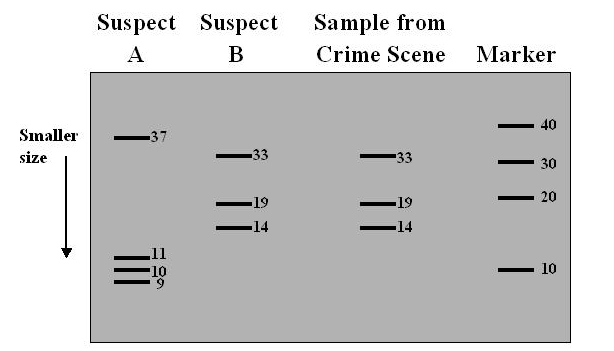
RFLP fragments separated on a gel extending the above analogy using sentence fragments.
In this case the sample from the crime scene matches suspect B.
The advantage of RFLP DNA sequencing is that it gives astronomical odds against a false match. The disadvantage is, that to get enough DNA to appear, thousands of cells, each with a copy of the DNA is needed. This is fine if you are collecting blood from a suspect, but there may not be enough DNA to test in a drop of blood or semen at the crime scene.
In the first forensic application of "DNA fingerprinting," 17 year old Richard Buckland had confessed to the rape and murder of a young girl. The police claimed that he had provided information on the crime only the perpetrator would know. The police suspected that he was also responsible for a second murder. The DNA samples came back and proved the two crimes were connected - and that the suspect in custody was innocent. The actual murderer was found by DNA matching.
HLA DQalpha
In order for DNA fingerprinting to better handle small samples, another technology was employed. PCR, polymerase chain reaction, is probably the most useful science tool developed in the past fifty years and has many applications in medicine and research. Large amounts of exact copies can be made of pieces of DNA. In theory only a single strand of DNA (from a single cell) is sufficient to generate enough material for forensic analysis.
The first DNA fingerprinting methods using PCR looked at an area of DNA that had been well characterized and was known to vary among different people, the HLA region, which determines tissue compatabilities. The method created was referred to as HLA DQalpha. While it could find DNA from a very small sample of evidence, it had a huge limitation: it only distinguished among six different types of the targeted gene. These gene types were designated 1.1, 1.2, 1.3, 2, 3 and 4. Individuals would have two of these, one inherited from each parent. Using DHQalpha tests all humans would fall into one of twenty one groups. Extensive studies were made of the frequencies of these gene types. Although HLA DQalpha is legitimately a DNA test, its ability to distinguish among samples could be thought of as being more akin to blood-typing than an unambiguous fingerprint.
These groups are:
|
Chromosome "A"
|
|
|
|
1.1
|
1.2
|
1.3
|
2
|
3
|
4
|
|
Chromosome "B"
|
1.1
|
1.1, 1.1
|
-
|
-
|
-
|
-
|
-
|
|
1.2
|
1.1, 1.2
|
1.2, 1.2
|
-
|
-
|
-
|
-
|
|
1.3
|
1.1, 1.3
|
1.2, 1.3
|
1.3, 1.3
|
-
|
-
|
-
|
|
2.0
|
1.1, 2
|
1.2, 2
|
1.3, 2
|
2, 2
|
-
|
-
|
|
3.0
|
1.1, 3
|
1.2, 3
|
1.3, 3
|
2, 3
|
3, 3
|
-
|
|
4.0
|
1.1, 4
|
1.2, 4
|
1.3, 4
|
2, 4
|
3, 4
|
4, 4
|
Copies of the HLA DQalpha area of the DNA sample are made using PCR. This product is then placed on a filter and tested by using probes that would only register positive to a specific gene type. The results look like the dot-test for pregnancy, although in this case, there were six possibilities for positive results.
This explains some of the limits of HLA DQalpha. Instead of multiple lines representing hundreds of millions of patterns, we have a series of eight dots whose appearance or lack of appearance define the HLA type on both chromosomes. This problem is even worse with mixed samples. An evidence sample reading 1.1, 4 could represent a single person with a HLA DQalpha type of 1.1, 4, or two or more people with 1.1, 1.1 and 1.1, 4 or 1.1, 4 and 4, 4, or 1.1, 4 and 1.2, 4, etc.
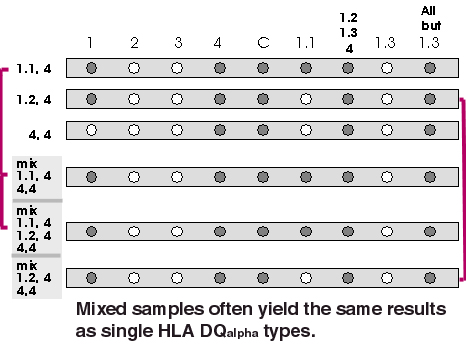
Samples connected by red show the same results.
Another potential limitation of PCR methods is that it is simple to make copies of contaminations. If even one cell or one strand of DNA gets into the wrong sample tube, it can leading to incorrect results. Anyone who has worked with PCR for any length of time has experienced sample contamination. Negative controls are run - these are samples without any added DNA and for which no bands should appear.
HLA DQalpha played a role in the West Memphis case although the tests gave ambiguous results. There were three important evidence samples tested. One was a blood stain on a T-shirt from Jessie Misskelley. A second was blood on a knife from John Mark Byers. A third was blood on a pendant worn by Jason Baldwin and Damien Echols. These samples were compared to those of the victims, the three defendants, and the members of the Byers household. (John Mark Byers is not genetically related to Chris Byers.)
The HLA DQalpha types were:
Expected Frequency cited
Name/sample HLA DQalpha alleles Frequency* by Genetic Designs
Chris Byers 1.1, 4 3.8% 9.2%
Michael Moore 4, 4 7.9% 7.2%
Steve Branch 1.2, 4 5.8%
T-shirt 4, 4 7.9% 7.2%
Knife 1.1, 4 3.8% 9.2%
Pendant 1.2, 4 5.8%
Damien Echols 2, 3 2.5%
Jason Baldwin 1.2, 4 5.8%
Jessie Misskelley 4, 4 7.9% 7.2%
John Mark Byers 1.1, 4 3.8% 9.2%
Melissa Byers 1.1, 3 2.5%
Ryan Clark 1.1, 3 2.5%
The results were maddening. The blood on Misskelley's t-shirt matched Michael Moore, suggesting guilt but also matched Jessie Misskelley, suggesting he had a shirt with his own blood on it. It was not introduced as evidence. The blood on the pendant matched Steve Branch and Jason Baldwin, and if were a mixed evidence sample could have been claimed to have also match Michael Moore. The judge disallowed this from being introduced as evidence, in part because of its late appearance during the trials. The blood on the knife matched Chris Byers, and his stepfather, John Mark Byers, and as a mixed evidence sample could have been claimed to have also matched Michael Moore and Stevie Branch. It was introduced at trial with John Mark Byers contradicting his earlier statements to police stating he had cut himself with the knife.
The relatively poor resolution of HLA DQalpha is only a partial explanation for these ambiguities. With likelihoods of matches being less than 10%, the probability of having all three items point both to guilt and exculpation is highly unlikely. The HLA DQalpha types of the three victims had corresponding matches with the suspects Jessie Misskelley, Jason Baldwin and Mark Byers. While evidence samples matching can be the result of a suspect being the source of the sample, victims having the same types as suspects is highly improbable or indicative of PCR contamination.
RFLP is limited by not being able to work with small sample size, a problem exacerbated by sample deterioration. HLA DQalpha can handle small sample size but has poor powers of discrimination. Modern DNA Fingerprinting overcomes these limitations by combining the best of RFLP with the best of HLA DQalpha.
Continued in Part Two. Modern DNA analysis.
*Expected frequencies were calculated using Hardy-Weinburg distribution assumptions and data from 3094 Caucasian Americans as presented in "The Distribution of the Human DNA-PCR Polymorphisms," copyright 2002, Huckenbeck and Scheil. |