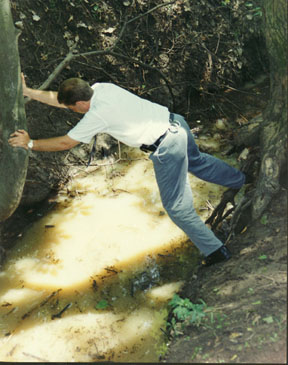 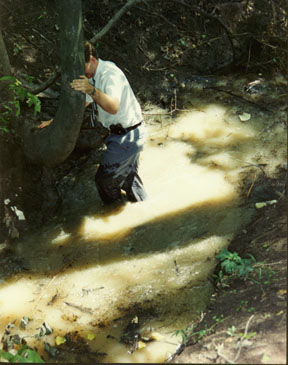
Sgt. Mike Allen poised over the creek water (Exhibit 10) and falling in (Exhibit 11).
Det. Diane Hester, photographer.
Officers and volunteers had covered the area where the bodies were found several times before discovering the bodies in the water, [Inspector] Gitchell said. "That area where the boys were found was saturated hard and heavy that morning and even the evening before," he said. [West Memphis Evening Times, May 7, 1993]
The Discovery
The hub-bub of the early morning search had quieted down. According to Blood of Innocents, "Authorities suspended most of the search by noon, sending neighbors home to rest and allowing the volunteer rescue squad members to report to their regular jobs." [BOI, p. 49] After the other searchers had left the woods behind the Blue Beacon, assistant probation officer Steve Jones stayed behind.
Jones said he was in the woods assisting the search when he saw the clothing in the water. Most of the people searching that day missed the clothing because one had to stand right at the edge of the bank and look straight down, Jones said. "I found the boys scout cap," Jones said, saying he then radioed Allen for help. "I felt like they had been out there swimming" and drowned. [Blood of Innocents, p. 416]
Although cited as a cap (above), other versions say Jones found one shoe - or two. To add to the confusion, the account presented to the media eliminated Jones from the story.
According to Gitchell, this area had been well-covered already during the search efforts, although he attributed the discovery to one of his officers. "One of my men noticed a shoe. Being inquisitive, he jumped in the water and started feeling around," Gitchell explained. "People have been walking though (sic) here all day. We were lucky he (the officer) saw one shoe." [West Memphis Evening Times, May 7, 1993]
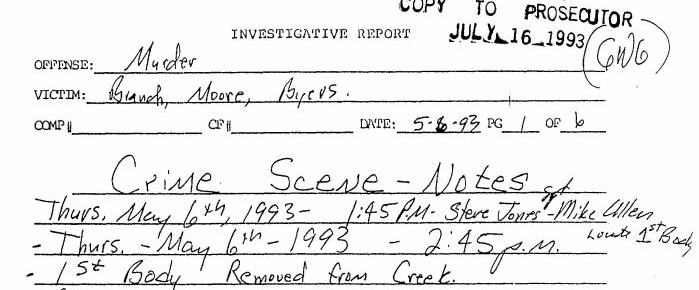
Thurs. May 6th, 1993- 1:45 P.M. Steve Jones - Sgt. Mike Allen Locate 1st Body
Thurs. - May 6th - 1993 - 2:45 p.m. - 1st Body Removed from Creek.
Jones radioed the police dispatch and the officers responded. Allen described entering the woods behind Phillips and encountering Denver Reed, the head of Search and Rescue.
Allen: I think Denver had - was leaving out as we [Phillips and Allen] were - we were coming in. [snip] Steve Jones who is a juvenile officer was at the location that had observed the shoe and I guess him and Denver were in that area at that time searching. [Mike Allen, Echols/Baldwin trial]
Detective Diane Hester followed shortly behind and would photograph Sgt. Mike Allen as he approached the water where the shoe was, leaned over and went in. The testimony in the Misskelley trial was a matter of fact account, suggesting Allen had intended to enter the water.
Fogleman: When you got to that area what, if anything, unusual did you see in the creek?
Allen: I was pointed out a - I observed what appeared to be two small tennis shoes floating in the creek.
Fogleman: Now, after seeing these tennis shoes, what did you do?
Allen: I went - we were on top of a bank there, I would say ten to fifteen foot down to where the creek was. I went to an area where I felt I could cross which I crossed and went around to the area where the tennis shoes were in the water.
Fogleman: Alright. And, uh, did you get in the water?
Allen: Yes, sir. I did.
In the Echols/Baldwin trial, Allen made it clear he fell in.
Allen: This is - this photograph here reflects me crossing this ditch to get on the other side, there's the tennis shoe that I observed was there's like a cliff right here and it was where I had to go down to cross to get on the other side to get closer to where I could uh - observe the tennis shoe.
Fogleman: Is that prior to discovering any of the victims?
Allen: Yes, that's when I first got into this area.
Fogleman: Alright. And were you able to make it across without getting into the water?
Allen: No sir, I uh - fell into the water here uh - in exhibit 11, and came up the bank here and around over to the area where the tennis shoe was, up the ditch here. [Echols/Baldwin trial]
Under cross-examination, Baldwin's attorney attacked.
Ford: When you and Officer Hester were walking into the woods, were you all just clicking photographs one right after the other, one right after the other trying to catch each and everything that you all did? So she just happened to catch you leaning across the ditch, just happened to catch you falling in the ditch - just by luck, when nobody even knew that you were going to find anything - nothing significant had occurred, but you all just happened to be taking photographs - is that correct?
Allen: Diane Hester at that point was before we realized that we had a tragedy of this - of this nature and at that time, I think she took those photographs 'cause she was poking fun at me because I was fixing to fall uh - in the water. [snip]
Ford: Because she thought you were fixing to fall in the water, right? She thought you were fixing to fall in the water so she said "Well I'll just take a picture, this may be funny" [ibid]
Ford suggested the photos were staged (although not why). The difference in the watches in the above photos was cited as evidence.
Ford: Look at state's exhibit number 11, what color is the face on your watch?
Allen: It's the same watch I have on right here.
Ford: Black? A black face?
Allen: Yes, it's the same watch I've got on right here.
Ford: And what color is the watch face you have now?
Allen: It's black, it's the same color.
Ford: Show you state's exhibit number 10, what color is the face on that watch?
Allen: This is -
Ford: It's white, isn't it?
Allen: I have not changed watches. (chuckle)
Ford: It's white, isn't it?
Allen: It's like a reflection, I'm sure. [snip]
Ford: Did you go back Seargent, after this was - later, and take these photographs - stage these photographs? With different watches on.
Allen: (chuckle) No sir. That's absurd. [ibid]
Judge Burnett was not impressed with this line of questioning. "I don't see whether it makes one bit of difference one way or the other. They've been asking what kind of watch you had on and who took the pictures - what difference does any of it make?" [Burnett, ibid]
Ford wouldn't let go of this point and used it in his closing argument.
Ford: Next we have Mike Allen. Mike Allen wants you to believe that he and Lieutenant Hester are walking through these woods looking for three eight-year-old boys carrying a photograph -- carrying a camera -- and taking photographs because it might be funny if I fall in the water. I wouldn’t think there would be a sense of humor left if you’re looking in the woods for three eight-year-old boys. But yet they have the time to make pictures out of -- make pictures that are funny. And they’re perfect. She must be an outstanding photographer to take that and not only get him as he’s leaning across but get him as soon as he falls in the water. She is a good photographer. I submit to you those photographs were staged. Why would you take pictures before you found anything? Why would you take pictures for a joke?
After Allen fell in the water he found he was standing on something solid - Michael Moore.
Allen: My intentions were to get into the water and reach for the tennis shoe at which time, when I got into the water, I felt, uh, I felt an object in the water. I raised my right foot up, and a body floated to the surface of the water. [Misskelley trial]
Allen had dislodged Moore from the mud at the bottom of the creek. Hester radioed for Inspector Gary Gitchell. Steve Jones departed.
Allen: When I found the first body, Steve Jones left in a rather hurried fashion - sick. [Echols/Baldwin trial]
Although Allen had been called in at 1:14 pm, it was 1:45 pm before the noted encounter of the first body and another hour before the body was taken from the water and the discovery of the other bodies. The reason for the delay was not made clear, although it can be speculated some time was needed for securing the scene and better documenting the recovery.
Lieutentant Bryn Ridge, wearing jeans and an University of Arkansas Razorbacks T-shirt. was searching three miles to the east on his three wheel ATV when he was called to the scene. When he arrived Mike Allen was still in the water.
Ridge: I got into the water north of the bodies, north of the victim that had been located, who was, we'd discovered was Michael Moore, and I proceeded to work my way through the water through the ditch, and being careful not to destroy any evidence, I was searching the bottom of the ditch as I made my way to the body. I found some clothing items.
Fogleman: Okay when you say you were searching the bottom of the ditch what do you mean?
Ridge: Okay. Obviously you can't see into this muddy water, so, the best way to describe it is I actually do it from the water level, I was raking my hands from one bank of the water to where it came out on the other side along the bottom all the way.
Ridge estimated the water as being 28 to 30 inches. At 2:56 p.m., 27 feet south of Moore he encountered Stevie Branch. Five feet further at 2:59 p.m. he encountered Christopher Byers. The children were removed from the water and the items of clothing were piled on the riverbank.
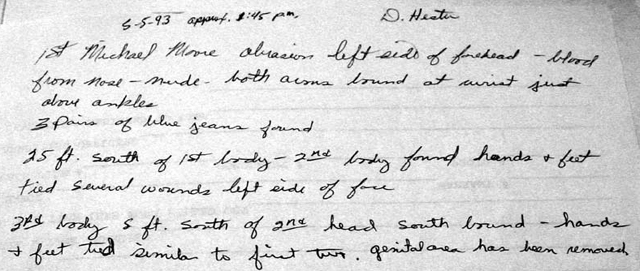
Crime scene notes, Diane Hester (5-6-93)
At 3:55 pm, County Coroner Kent Hale arrived on the scene. He tested the bodies for blanching with lividity but did not take core body temperatures or test for rigor mortis. He would say he didn't want to take a rectal temperature because it would destroy possible rape evidence and he didn't want to test for stiffness because it would involve removing the bindings. He pronounced the children dead.
Aftermath.
Allen and Ridge stayed at the crime scene until 8:30 pm. At that time they went to the Bojangles restaurant to speak with Manager Marty King following up on the story of a mysterious bloodied black man who had appeared there the night before. They would take notes, a scraping of blood from the wall and leave. This physical evidence was lost.
The next day Allen and Ridge would be part of a grid search of the woods and the nearby meadow. Their conclusion that the meadow did not have tire tracks was cited by the prosecution that the bodies could not have been brought in from that direction by automobile.
Allen and Ridge would continue to play major roles in the investigation. Allen interviewed various suspects including Beasley and Williams, Tracy Laxton, and Jessie Misskelley prior to his confession. Detectives Ridge and Sudbury would interview John Mark Byers and James K. Martin. Ridge would elicit the confession from Jessie Misskelley. Both Ridge and Allen continue to work for the West Memphis Police Department with Allen now Chief of Detectives.
Having quickly fled the scene, Steve Jones was shaken by the experience. He compared notes with Detective James Sudbury.
On the day after the bodies of the three boys were found I had a conversation with Steve Jones, a Juvenile Officer for Crittenden County, Arkansas. In our conversation I found that Steve and I shared the same opinion that the murders appeared to have overtones of a cult sacrifice. During our conversation Steve mentioned that of all the people known by him to be involved in cult type activities one person stood out in his mind, that in his opinion, was capable of being involved in this type of crime. That person was Damien Echols. [Sudbury notes]
That same day, on May 7th, they would go to interview Damien Echols in his trailer.
In 1995, at the time Jerry Driver was under scrutiny for embezzling funds, Jones would resign from his post. He would relocate to northwest Arkansas.
As of 2007, at age 74, Denver Reed continues to work with the Search and Rescue.
Sudbury would be entangled in a scandal for embezzling funds and be forced out of the department.
Hester would go on to interview many of the suspects and witnesses including Otto Bailey, Bryan Woody and Jimmy Sellers. She would interview many of the children for their stories. Her office is where Jessie Misskelley was interviewed on June 3rd.
The room which we used to interview Jessie in was Detective Lieutenant Hester's -- she's a female police officer at the police department. Her room is probably the nicest room that we have in the detectives' division. She has pictures of her children, colorings that they've done in school saying 'Mother, I love you,' things of that nature. So it's probably the most relaxed atmosphere that we have in the police department. [Gary Gitchell, Misskelley trial]
She continues to work for the West Memphis Police.
Perspective.
The story of the discovery of the victims underscores how this was not a normal case. In other searches, the parole officer of the (eventually convicted) murderer is not the discoverer of the victims. In a large and widespread hunt, the head of Search and Rescue is rarely present at the time of the discovery. Denver Reed and Bryn Ridge began their days searching the site. In an ordinary case, the encounter of the victims and the story of the discoverers is well documented and not left to be brought out at trial.
The defense attorney Ford was reduced to wild speculations because he did not have access to the basic information that could make sense of the story. Why would Reed leave the site even before the first victim was discovered? A shoe (or cap) in the water is unnerving, but hardly proof of discovery. Looking at the photos of the small and fetid ditch, how is it possible that Steve Jones could imagine the children were swimming there and drowned? Perhaps one freak accident, but three? With the urgency of the search, why did the Search and Rescue squad disband at noon?
Perhaps there are benign explanations for some or all of the unanswered questions about the discovery, but once again this case lacks the most fundamental police work, including accounts from Jones, Reed, Phillips and Hester and any statements short of trial from Allen and Ridge. There are no statements from the evening staff of the Blue Beacon or Billy Sanders. Were there suspicious persons lurking in the area at the time? What was the circumstances of the accident at the Blue Beacon minutes before the discovery? These questions should have been answered.
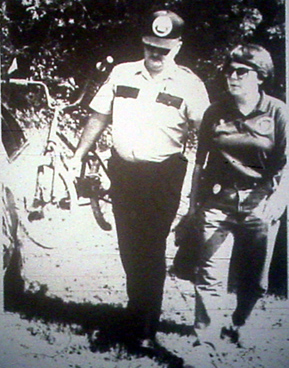 
Left. Officer Ricky McKay, accompanied by Diane Hester, carries a recovered bicycle.
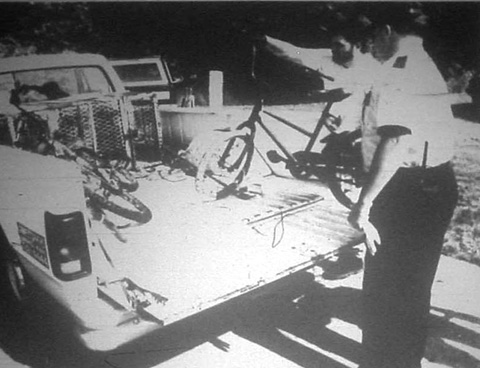
Right. McKay and Detective Griffin load a bicycle on the back of the pet control vehicle.
McKay's family would be part of Damien Echols alibi. |